Tudor ideas
Oct. 12th, 2005 06:52 pm![[personal profile]](https://www.dreamwidth.org/img/silk/identity/user.png) frualeydis
frualeydisTudor ideas.
I have been thinking a lot about my plans for a Tudor dress. Not the wool dress with the giant beret, I’m pretty clear what I’m going to do with that one, when I find the right fabric.
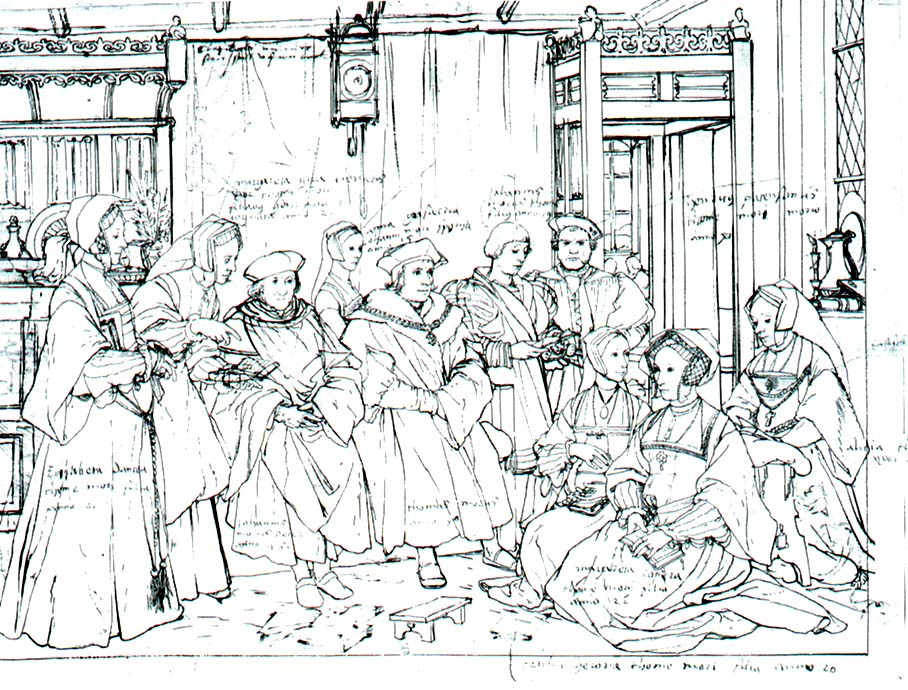
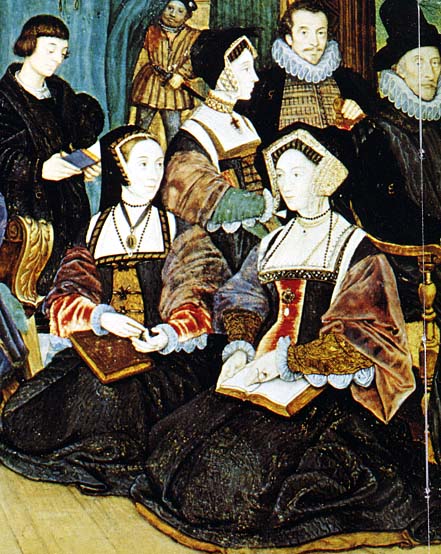
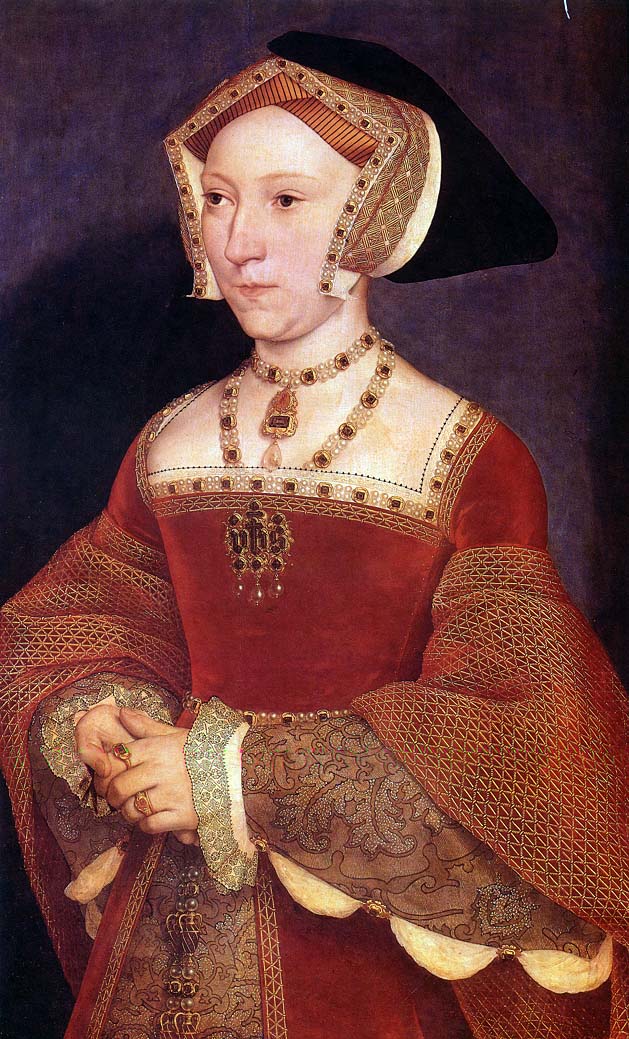
No it’s for the noble gown. I’ve always liked the gowns in Holbein’s sketch of Thomas More’s family. It is important here to look at the sketch and not the later copies of the now lost painting, like this. If you look at the sketch all the women that have the open laced gown are pregnant. Two women, one sitting to the right and one standing to the left aren’t pregnant (at least visibly) and also do not have the open gown, but gowns with closed bodices. On the left you can’t see much, but the woman on the right seems to have an either back-laced gown, which is unlikely, or a gown that has a plastron that’s pinned to the side, like in the famous Jane Seymour portrait. So, my theory is that these are the same type of gown, with and without plastrons, that we see how they looked under the plastron.
Since your belly grows much more than you breasts it is likely that the gown originally had a triangular opening that closed at the waist but was open at the neck (or more accurately: bosom). A slit in the skirt made it possible to get into and accommodated the growing belly.
In earlier portraits, like this of Catherine of Aragon and this of Agniete van den Rijne you see the edges of a kirtle, or something, that don't meet. On both Catherine and Agniete you can see that they lean inwards so that they will meet at the waist. That makes it at least four layers that they’re wearing: A shift, a kirtle or tunic under the kirtle/under gown with the triangular front opening and then a gown, which is front-closed in Agniete’s case and lacks visible closing on Catherine’s portrait.
At first I thought that that the gowns in the More sketch were this type of kirtle/under gown, but that is not possible because of the sleeves, the gowns in the sketch have the typical huge Tudor sleeves. Sleeves which are on the other, outer gown on the Catherine and Agniete portraits. So I thought: there is some time between these portraits (and Agniete’s is Dutch, but I don’t think that matters that much). Maybe they also though it was cumbersome with four layers, or five if you include a corset and changed the under gown into the outer gown, by adding the plastron and putting the large sleeves on it. It could have something to do with the introduction of the corset maybe, that all these layers were used to lift the bust and give a smooth line, but that they weren’t needed when the corset appeared. But that is just idle speculation. About the corset I mean, the rest seems pretty plausible to me.
But does it seem plausible to you?
I have been thinking a lot about my plans for a Tudor dress. Not the wool dress with the giant beret, I’m pretty clear what I’m going to do with that one, when I find the right fabric.
No it’s for the noble gown. I’ve always liked the gowns in Holbein’s sketch of Thomas More’s family. It is important here to look at the sketch and not the later copies of the now lost painting, like this. If you look at the sketch all the women that have the open laced gown are pregnant. Two women, one sitting to the right and one standing to the left aren’t pregnant (at least visibly) and also do not have the open gown, but gowns with closed bodices. On the left you can’t see much, but the woman on the right seems to have an either back-laced gown, which is unlikely, or a gown that has a plastron that’s pinned to the side, like in the famous Jane Seymour portrait. So, my theory is that these are the same type of gown, with and without plastrons, that we see how they looked under the plastron.
Since your belly grows much more than you breasts it is likely that the gown originally had a triangular opening that closed at the waist but was open at the neck (or more accurately: bosom). A slit in the skirt made it possible to get into and accommodated the growing belly.
In earlier portraits, like this of Catherine of Aragon and this of Agniete van den Rijne you see the edges of a kirtle, or something, that don't meet. On both Catherine and Agniete you can see that they lean inwards so that they will meet at the waist. That makes it at least four layers that they’re wearing: A shift, a kirtle or tunic under the kirtle/under gown with the triangular front opening and then a gown, which is front-closed in Agniete’s case and lacks visible closing on Catherine’s portrait.
At first I thought that that the gowns in the More sketch were this type of kirtle/under gown, but that is not possible because of the sleeves, the gowns in the sketch have the typical huge Tudor sleeves. Sleeves which are on the other, outer gown on the Catherine and Agniete portraits. So I thought: there is some time between these portraits (and Agniete’s is Dutch, but I don’t think that matters that much). Maybe they also though it was cumbersome with four layers, or five if you include a corset and changed the under gown into the outer gown, by adding the plastron and putting the large sleeves on it. It could have something to do with the introduction of the corset maybe, that all these layers were used to lift the bust and give a smooth line, but that they weren’t needed when the corset appeared. But that is just idle speculation. About the corset I mean, the rest seems pretty plausible to me.
But does it seem plausible to you?

![[identity profile]](https://www.dreamwidth.org/img/silk/identity/openid.png)

no subject
Date: 2005-10-12 11:15 pm (UTC)One thing that I also noted was the dresses do not have open front skirts, which most (all?) of the closed front plaston/stomacher dresses do seem to have.
This is where I begin to wonder if they are really the same dresses sans stomacher/plastron. I can see the need for a plaston/stomacher if you want to keep the appearance of a closed front bodice with a split skirt; because skirts and bodices are joined you need a front fastening bodice.
http://www.uvm.edu/~hag/sca/tudor/backsketch.jpg
I also look at this sketch of a burghers wife who appears to have the same type of open fronted gown, but with fitten sleeves.
I'm wondering if it's simply another style that lived alond side the closed fronted-open skirted style. Less popular possibly. And was more convenient for an expanding belly?
2 cents from someone who doesn't know
Date: 2005-10-13 01:10 am (UTC)But the stuff before "makes it at least four layers" sounds pretty plausible. You might want to check with
And this isn't helping, but if it were me, I draw the line at three layers. :-) (Not including a coat or layers for warmth.)
Re: 2 cents from someone who doesn't know
Date: 2005-10-13 05:04 am (UTC)I thought four layers was a bit much myself, but she _must_ have a shift although we can't see it.
Eva
no subject
Date: 2005-10-13 05:16 am (UTC)Anyway, the best way of finding out is to test it. The only difference I can see between this way of doing it and the more commmon way is that the bodice that is laced under the plastron is v-shaped and doesn't close all the way. Other than that it's just a laced bodice with the pinned on plastron.
Eva
no subject
Date: 2005-10-13 02:59 pm (UTC)no subject
Date: 2005-10-14 08:32 am (UTC)(I never got past pattern drawing)
But i'm looking forward to seeing how you end up starching the open under kirtle, - cause if it's going to be able to lay as smoothly as they do in most paintings, it has to have some boning, but if it's going to still be comfy when pregnant (you can see the edges on the openfront gowns bending outwards around the tummy) it can't be too stiff either, and they don't look as if they are using whalebone in the holbein drawings. And they ony tie it closed with 3-4 strings, which usually would mean that quite a bit of stiffening is required.
PS: You can see the pins on the plastron even more clearly in the portrait of lady pemberton.
PPS: In the one portrait of mary tudor in hte black silk dress, you can see a front closure through the plastron, - but it doesn't look like it's tied close.
I'll shut tp now, but How i love tudors!
no subject
Date: 2005-10-18 08:27 am (UTC)I think you're right except *possibly* in this. I've always throguth they were made to fasten edge to edge ip the front and could be spread wider to accomodate larger belly during pregnancy, or in a V to accomodate times of larger bust (weight gain, nursing mothers etc).
The possibility they were *designed* to be worn with the V opening never really occured to me... but it mhas merits.
Teddy