"English transitional hood"
Jan. 21st, 2006 09:37 am![[personal profile]](https://www.dreamwidth.org/img/silk/identity/user.png) frualeydis
frualeydisI am primarily adressing ![[livejournal.com profile]](https://www.dreamwidth.org/img/external/lj-userinfo.gif) myladyswardrobe and ninya_mikhaila, but I would love help from any of you.
myladyswardrobe and ninya_mikhaila, but I would love help from any of you.
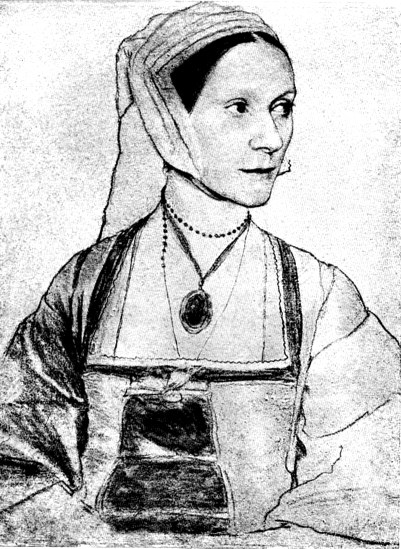
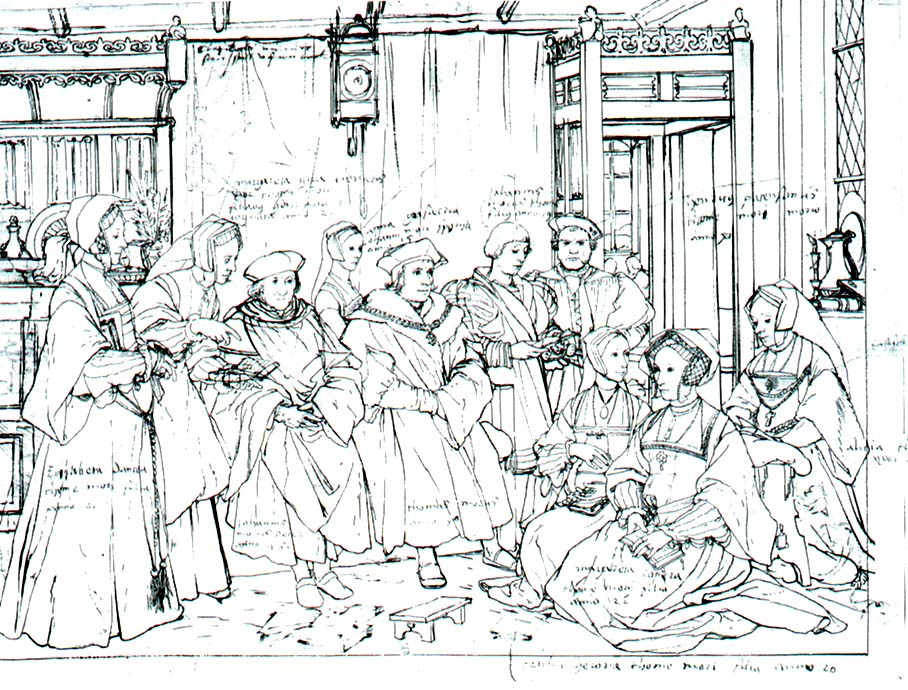
I have some question about what Drea Leed calls the "english transitional hood". I think they are way cool and want to make one for my new dress. The dress is based on Holbein's sketch of the More family, where two of the women wear this kind of hood. He has also drawn it on other sketches. But what I do wonder is if anybody has seen this type of hood in colour (I'm not counting the later copy of the More family portrait, you can't use that as a primary source) since I don't know what kind of material and colours to use.
myladyswardrobe and ninya_mikhaila, but I would love help from any of you. I have some question about what Drea Leed calls the "english transitional hood". I think they are way cool and want to make one for my new dress. The dress is based on Holbein's sketch of the More family, where two of the women wear this kind of hood. He has also drawn it on other sketches. But what I do wonder is if anybody has seen this type of hood in colour (I'm not counting the later copy of the More family portrait, you can't use that as a primary source) since I don't know what kind of material and colours to use.
![[identity profile]](https://www.dreamwidth.org/img/silk/identity/openid.png)
no subject
Date: 2006-01-21 09:39 am (UTC)Can't find anything else other than this one at the moment. Ninya may well have some effigies with this kind of hood, but I don't know.
Hope it helps.
no subject
Date: 2006-01-21 10:14 am (UTC)Eva
no subject
Date: 2006-01-21 11:09 am (UTC)The first layer is the white bit. Then there is a yellow bit which I think matches the underkirtle which you can see peeking out from the over gown.
Then you have the velvet/silk as the main part of the hood. I also think the yellows trim on the front edge of the black velvet may be the base for a jewelled trim.
no subject
Date: 2006-01-21 11:40 am (UTC)Eva
no subject
Date: 2006-01-21 04:30 pm (UTC)no subject
Date: 2006-01-21 09:27 pm (UTC)Eva